When we follow the path of least resistance, we allow our Lower Self to run the show. We align with our negative intention to stay stuck. This won't change until we explore the depths of our unconscious.
When we start doing the work of self-knowing, this is where we must go—into the dark regions of our psyche. We can't get to know our light—to connect with our Higher Self at our core—without discovering what is currently blocking it in our layers of Lower Self.
This self-transformation process involves uncovering difficult truths. Who am I, right now? Where do I say no, and why? How does this serve me?
If we didn't believe our negativity was somehow serving us, we would have no reason to hold on to it. Instead, we say no without knowing why. As a result, our lives are out of balance and we live in a state of disorder.
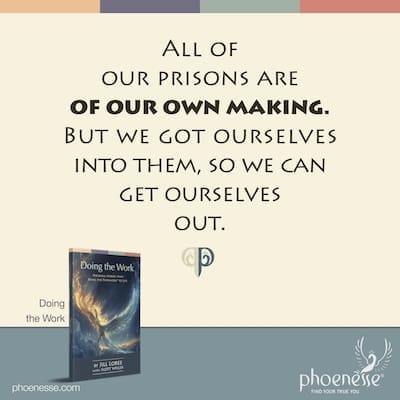
All of our prisons are of our own making. But we got ourselves into them, so we can get ourselves out.
There are no shortcuts
This work of spiritual development is gradual. It takes time and effort. And there are no shortcuts.
There is a spiritual law that says we can't skip steps. We may want to be further ahead than we are, to be seen as more "spiritual" than we currently are. When we do this type of spiritual bypassing, we slow our progress.
Our goal on this path is to know ourselves. In our current condition, we have both lightness and darkness within. To be in truth, we must see both sides of ourselves—as we currently are. To do otherwise is to violate spiritual laws.
Whenever we are not aligned with truth, we are not following spiritual laws.
God's spiritual laws have been carefully crafted to assure that the further we deviate from them, the greater our pain and suffering will be. We have free will, and this gives us the incentive to use it in a way that eventually returns us to our true home.
Our understanding of free will is essential for understanding God. God has free will. Therefore, if we didn't have it, we could never return to God. Because we wouldn't be compatible with God.
The work of transforming our Lower Self takes effort. In fact, it is a divine law that we must make an effort if we want to have the best in life—which is exactly what God wants for us.
There is always a price to pay for having what we truly want. What is the price? Our willingness to do the work.
This is how we become enlightened: by gaining more and more connection with our own inner light.
It's time to wake up
The Pathwork Guide calls enlightenment the willingness to explore and unwind every disharmony. Then we will find its divine kernel. Every darkness harbors light within, and this light can always be restored.
To do this work, then, does not mean we are "all better." That we have no more material to uncover and transform.
Rather, it means that we are ready to turn attention to our current reality. To do this, we must start feeling what we feel. We need to watch ourselves in action, and this may be uncomfortable.
This is what we have been avoiding. It's why we have turned away from ourselves. Through our self-created blindness, we have lost our connection with the divine. We have disconnected from our Higher Selves.
Often, in our confusion, we make a virtue out of our faults. We court temptation and keep secrets, identifying with our Lower Self instead of learning to identify it. Eventually, we come to believe that this is the truth of who we are.
It's time to wake up.
It's time to see the whole truth.
Our work, then, is to turn and face ourselves. We must start to feel and see what we have not been willing to face, until now. Nothing can be avoided if we want to transform our Lower Self and learn to live from our divine essence.
Although darkness is not our ultimate destiny, it's what's here now. Knowing ourselves means knowing how—in what specific ways—we want to cheat life.
We must come to realize we are the ones who have chosen darkness. No one did this to us. Our prisons are of our own making. Since we got ourselves into them, we must get ourselves out.
We are the only ones, in fact, who can do this. We will need help, of course, but no one else can or should do this for us. To believe otherwise is to live in wishful thinking.
Finding the divine within
It's not easy to look within, to see where darkness lives inside us. It is humbling and requires a certain commitment. Until we become more skilled at self-discovery, we will often see in someone else what we haven't been willing to see in ourselves.
When we see it outside ourselves, it bothers us greatly. For example, we may have a fault of procrastination that we think is sort of charming. We know this about ourselves, but we like it. Yet when we experience this in someone else, we are highly irritated by it.
What makes our negativity so hard to overcome is that our Lower Self is highly charged. It is always made from a twisted stream of Higher Self energy. This is why our faults can be so hard to let go of.
What can help is to find the divine essence within them. For instance, underneath our fearfulness is caution and an awareness that something is amiss. Our anxiety is a gauge that tells us something is being repressed that we don't wish to see.
Negative pleasure works the same way. It's based on our basic nature of needing pleasure. Simply put, people cannot live without pleasure.
When a child has painful experiences—as all children do—it attaches its pleasure principle to the negative event. Later, as an adult, the person will need to recreate that same unpleasant condition to activate their life force—to come alive.
This is why it's so hard to let go of the dramas in our lives.
Our stories of struggle feel electrifying, but they don't feel good. Nonetheless, we can't let go of them. But it doesn't have to be this way.
We can unwind any distortion and find the beauty inside the beast.
Relationships are a path within a path
There are two key principles that govern the creative process. They are the active principle and the receptive principle. They must work in balance for positive, harmonious creation to happen.
When they are out of balance, we create disharmony.
The active principle carries our "make it happen" energy. From here we engage with life, make an effort, and reach out. The receptive principle holds our "let it happen" energy. From here we allow, relax and let be.
When these divine principles operate in harmony, we experience mobility in relaxation. In this highly desirable state, our creations feel like effortless effort.
We humans embody these two concepts through our masculinity and femininity. Our work comes alive in our relationships. There is, in fact, great spiritual significance in our relationships.
If we want a good gauge for how we are progressing spiritually, we can simply look at the quality of our relationships. Where is there struggle and strife? Where is there harmony and ease?
The Pathwork Guide calls relationships a "path within a path." Our partners in life—especially our intimate partners—are uniquely effective at bringing our work to the surface.
By exploring any conflict with the people in our lives, and working together to unravel our difficulties, we can progress much faster on our spiritual path.

In Jill's Experience
I worked for 15 years at a company that made high-performance plastics. I started working there about the same time I began studying the Pathwork teachings. After about five years, I began training to become a Pathwork Helper.
For more than a decade, I felt like I was living in two separate worlds.
My day job was filled with scientists and engineers, spreadsheets and presentations. My weekends were spent with my kids. But my spare time went to reading Pathwork lectures, attending Pathwork workshops, going to spiritual retreats.
I was a hard-working employee, and I mostly liked my work. But every now and then I would pause and say to myself, I didn't come here to sell plastic pellets. That's not why I am here.
It's a challenge to be "in the world but not of the world." To take care of the responsibilities involved with work, family and home. And then to also go deep in your personal self-development.
When I travelled to Sevenoaks Retreat Center, which was operated by the Mid-Atlantic Pathwork, I felt like I had stepped into another world—another dimension. I processed deep feelings and had amazing insights. I felt a deeper, fuller connection with myself and with nature.
I learned from the Pathwork Guide's teaching that connecting with our Higher Self connects us with true reality. I could feel the truth of this.
I spent many years feeling my life was generally over-scheduled. Never once, though, have I regretted doing this spiritual work.
I am certain that at the end of this life, what I will treasure most from those years is the time I spent with my kids, and time I invested in my spiritual path.
What I did to earn money will hardly rate a mention.
In Scott's Experience
The Pathwork Guide describes this path as following a spiral. Before we start doing this work, we are going around and around in circles, not realizing that we keep repeating the same patterns, getting nowhere.
When we do this work, we slowly rise up out of the circle. The path then becomes an upward spiral.
But it's not a constant upward movement.
It's more like a slanted spiral. It has a downward phase, followed by an upward phase. Each turn has downward and upward phases, but overall it gains a little height with each turn of the spiral.
In the downward phase I would plunge into the difficult aspects of my work. In those times I came face-to-face with the parts of me that I needed to see and work with: my images, erroneous beliefs, inner splits and destructive No to life.
This phase of the spiral was not pleasant. Everything felt sluggish. The world became dimmer and more confusing. It was hard to pray.
After some time the upward phase would come. Then it felt like I came up out of the depths. Life was brighter and my difficulties eased. The situations I found myself in felt clearer. I had more perspective and some rest.
Then the next downward phase would begin.
One part of me kept trying to push this away, to hang onto the more pleasant phase and escape from the unpleasant phase. It was an instinctual reaction to like one part and dislike the other.
I had to focus on doing the exact opposite, which was to embrace and explore what came up. My difficulties and confusions were right on the surface and immediately accessible so it became a rich and productive time to work with my Helper.
This spiral became a living and highly reliable part of my life. I noticed it operating and becoming more and more obvious in my inner experience.
I didn't consciously create it or decide for myself when the phases should shift. It had its own varying rhythm, timing of phases, and amplitude. My only options were to fight it or flow with it.
As I flowed with it I discovered it was trustworthy.
To my amazement, my outer life largely seemed to flow in sync and harmony with this automatically-operating inner spiral movement.
Time after time the spiral held me just deep enough in my work, for just long enough that I could safely explore that part of me. Then it brought me out at just the right time, for just the right amount of rest.
Of course, the ego part of me didn't always agree with this assessment. When life felt difficult, I really wanted someone to "take this cup from me." It felt like it would never end.
Yet I knew it would. And it did.
I learned I could really trust the spiral movement. I could give myself completely to exploring the darker parts that came up because I knew the phases weren't endless.
I knew that I wouldn't be asked to take on too much in the moment, that I wasn't going to get lost in it, and that soon I would be riding up the spiral again, with more wisdom in hand each time.
Return to Doing the Work Contents