Stories, stories, stories. No doubt, we have some stories. Chances are, we like to tell them to anyone who will listen to our tales of woe.
Our goal is to bring people over to our side—to our way of seeing things.
The point is not that we shouldn't have our stories. Nor is the point that we should stop telling our stories.
What would be more helpful, though, is for us to start paying attention to the pitch of our stories. To the way we're making someone or some situation out to be all bad, all the while denying our own part.
This is called the blame game. What we're really playing with here is a limited reality called duality. We only see one side of things—how we've been wronged. What we don't yet realize is that, somehow—through our unconscious attitudes and beliefs—we set the whole thing up.
And at first it can be hard to see this.
The Pathwork teachings offer a very different and helpful way of understanding why we incarnated here, why our particular difficulties matter, and how to approach life.
To sort out the blame game, consider that we knew about this before we were even born. Prior to incarnating in this lifetime, our soul acquired some darkness that now needs our attention.
We reviewed this situation at great length, in conversation with older, wiser guides. Together, we agreed to a list of things we would work on during this lifetime.
To this end, we carefully selected our parents for their ability to bring our distortions to the surface in this lifetime. This is not done as a punishment. Rather, this is the only way for us to become aware of our "soul dents."
This awareness of our soul dents—along with the pain that results from them—is what compels us to work on resolving them. While happiness is always our final destiny, what really motivates us is our desire to stop experiencing pain.
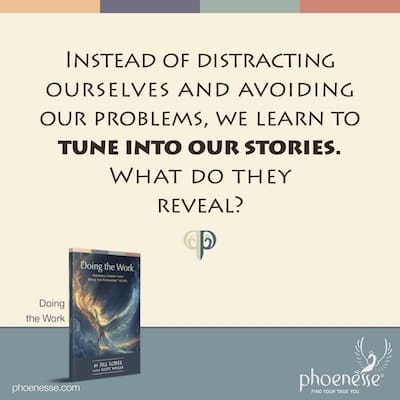
Instead of distracting ourselves and avoiding our problems, we learn to tune into our stories. What do they reveal?
What we, ourselves, create
As the Pathwork Guide teaches, all our negativity—including our faults, wrong beliefs, difficult feelings and destructiveness—cause us to feel pain. Yet all of these are merely twisted versions of something that was originally positive and divine.
We are the ones who, through use of our own free will, have done this twisting.
Further, the cause of our current suffering originated prior to this current incarnation. So now, due to the law of cause and effect—also known as karma, when it spans over many lifetimes—we have some clean-up work to do.
In short, we're here to rediscover our original face—our true beauty. And we can't, or won't, do that if we don't clearly see the aspects of ourselves that have lost their shine.
We can collectively sum up all of these less-than-positive qualities under an umbrella called the Lower Self. We're here, then, to transform our Lower Selves and restore our souls to their original, godlike condition.
This is our Higher Self. It's the essential aspect of ourselves that has never been tarnished or lost its direct connection with the divine. But now, parts of it are hidden by layers of Lower Self material.
There is one primary difference between the Lower Self and Higher Self: the Lower Self serves separation and the Higher Self serves connection.
Make a note of this. Every time we lose our way, we can re-orient ourselves by asking whether our choices are creating separation or connection.
We must make an effort
Of course, in reality, few things are so black and white. Often, we tend to have mixed motives.
The way out is to start making choices that connect us more deeply with our own true selves. We do this by aligning with our Higher Self. By squaring ourselves with our own inner divine self, we get square with God and divine will.
Before we can do this, we have to expose and transform our Lower Self. In short, we must see how we are currently lost in the darkness of duality.
Once we get this all straightened out, our lives will start to lighten up.
We can characterize the Lower Self by its signature moves, like being destructive and cruel. It is highly charged, since it takes Higher Self energy and distorts it. It is also stubborn, stuck and suffering, yet has no intention of changing.
Another character trait of the Lower Self is laziness. Plus it's immature. The Lower Self wants what it wants when it wants it. Further, it is not willing to pay the price for having a better life experience.
In truth, the Lower Self can't be transformed without effort.
Which part of us makes this effort? Our ego—the part of us that can directly choose—must reach out and engage our Higher Self.
This is important to understand: the work of transforming the Lower Self is always an act of the Higher Self. This means we must use our ego to start tending to and strengthening our connection with the Higher Self.
Listen for the pitch of the story
Our efforts with meditation pay off right here. We need to learn to listen to the quiet voice within. This will help us reorient ourselves when our Lower Self wants to act out.
That, friends, will happen, even as we walk a conscious path of healing.
This is no different than when we wander through life just hoping for the best. Our Lower Self attempts to undermine our best efforts at every step. In fact, it always acts against our own best interest.
Now, using the tools of these teachings and the help of someone who has gone this way ahead of us, we can take a new approach.
For example, instead of distracting ourselves and avoiding our problems, we learn to tune into them. We start by listening to our stories—both the stories we tell others and the ones we tell ourselves.
What do our stories reveal about the source of our struggle? How are we building a case against people and life, and therefore furthering separation?
Whenever we are building a case, we are aligning with our Lower Self. The more we go along with this, the more we are colluding with darkness, and falling even farther from God.

In Jill's Experience
I'd been following this path for almost twenty years, when I met Scott, a fellow traveler on this path. Over the course of our lengthy email exchange, which is how our relationship began, I heard myself bringing up stale stories about "how they done me wrong because I'm a woman."
A part of me is thinking, "Really, we're still on this?"
This, it seems, has been the story of my life.
It started when I was born to a very young couple who already had two boys, two and four years old. I heard "the boys and Jill" often throughout my childhood. The boys were a pair and I was odd-man-out, so to speak. All because I was a girl.
In fairness, no one got many needs met in my family. But I felt a particular form of exclusion. I now see that much of this stemmed from my mother who never fully embraced her own place in this world as a woman.
I also had work to do about being a female. Seldom have I felt that being of the female persuasion was a good thing.
To be fair, just out of college, I seemed to have benefitted from affirmative action. Still, in my mind, I didn't see how being a female had helped me on a chemistry test. I earned my grades the same way the boys did: I worked for them.
As an adult, I was charting a trail of unsatisfying career choices. Until one day, in pain and despair, I had a blinding glimpse of the obvious: the problem must be me. That's when I found the Pathwork.
The Pathwork Guide's teachings began illuminating my many areas in need of work. And I began doing this transformative work in earnest.
Like an old can of paint with the lid sealed shut, you can't pry it off with just one attempt. You have to go around the top, slowly working your way through layers of old dried paint. Eventually, the lid will come loose. But not after the first little prying.
That's how this issue of grappling with being a woman has been for me.
Because it showed up in my work, and it showed up in my marriage, and it showed up in my spiritual community. Of course it did. The problem lives in me, so it showed up everywhere I did.
What's more, it was connected with one of my other lifelong pains—the experience of not being spoken to. This childhood experience was integrally linked with my belief that there was something fundamentally wrong with me: I am female.
I brought this misconception in with me. Then, as we do, I manifested a life in which it seemed it was true. It seemed I wasn't spoken to for the simple reason that I was a girl.
Had I been a male, I could have fallen in with "the boys" and lived happily ever after. Ok, that's not true either. But so it seemed.
After years and years of work, I meet Scott. And wouldn't you know, a situation happens in which I feel he is not talking to me. Up go my defenses, down come my walls, and off runs my wounded inner child.
I am left feeling helpless and hopeless. Why does this always happen to me?
Here was the setup. Scott and I had gone on a ski-vacation together out West. Unfortunately, the snow was incredibly deep that year and still falling. The day we arrived, another five feet of fresh snow fell.
Here's proof you can have too much of a good thing. Powder up to our knees was like skiing through a flour factory. We both were struggling but doing our best to ski.
The following day, an avalanche closed the road to the ski hill. We delayed our start and then finally headed out to brave the elements. As Scott was driving in these challenging conditions, I was unaware of the feelings descending over him.
Fear was bubbling up and he was in his own inner reaction. He was in a funk. I just felt like I was being tuned out. He felt very far away.
To my unconscious mind, this "not-talking-to-me treatment" fell into an old slot. Oh, here it is. I expected this. In this hidden part of my being a conclusion had long ago been made that the reason people don't talk to me is that I'm a girl. This is a basic, unchangeable flaw that is wrong with me.
Without my conscious awareness, this wrong conclusion caused me to see Scott's reaction through my distorted lens. So I didn't check out what was happening for him. I thought it was all about me.
I made up a story about how this always happens to me. I believed, incorrectly, that he thought I wasn't worth talking to. I didn't surface and challenge my own inner wrong belief.
In Scott's Experience
At the time of our ski trip, Jill and I were early in our relationship. We were still finding the ground under our feet as a couple, while living in different cities.
When a work-colleague of mine called a short-notice work meeting in California's central valley, I spontaneously invited Jill to come along. We added a few days to the trip to try out the big mountain skiing we had both heard about in Lake Tahoe.
Spirits were high in Sacramento when we rented a 4×4 Jeep. But the weather deteriorated into a blizzard driving up Donner Pass. When the windshield washer fluid froze, I had to focus all my attention on seeing through the smeared front window.
I've become a seasoned winter driver living near Buffalo, but Lake Tahoe that evening was another world. Snow was piled 20 feet high everywhere we looked.
The next morning, following an arduous drive to the ski resort, we found only a few trails open. Squaw Valley was struggling to open the mountain after five feet of snow overnight, and it was still coming down.
We're here, we thought, so we headed up the lift to make the best of it. Without the right equipment and experience, though, it was a very tough time in such deep snow. We found ourselves in a white-out blizzard high on the mountain, made a scary descent, and called it a day.
It snowed all night, and the avalanche across the road to the resort wasn't a good start to the next day. We struggled through a second day of impossible conditions.
The drive back to our hotel was frightening. Our wiper fluid never thawed and the windshield was almost completely frozen over.
Some people yell, curse or act out in difficult conditions. I tend to become quiet, particularly when I'm outdoors or in nature. It is an inward listening, yes, but some of it was the inner child in me hunkering down until the storm passes.
One of my stories was that I am on my own. Help is not on the way, the cavalry is not coming, and I have to do it myself—whatever 'it' is.
By the third evening, I indeed had some funk on me. A lot more, in fact, than I was aware of. Which was bad enough. But, even worse, I didn't know why.
I didn't realize how much I was affecting Jill, or about Jill's story of not being spoken to as a child. To me, at the time, she "checked out" and I was carrying the load. But I was lost in my own story.
More truthfully, I wasn't able to stay present with her. Things went downhill from there. Not a steep downhill, but a steady glide.
A lot of learning was just around the corner…
Return to Doing the Work Contents