Our best efforts, using our ego mind alone, will land us at the doorstep of duality, every time. Because the ego itself is a fragmented aspect of consciousness, which means it is limited.
Left on its own, it has no depth or originality. It is not creative and it cannot love. It exists in duality and cannot hold opposites. It always wants to win, to be right, and to be better than others.
But it has some very valuable features. The ego can learn. It can decide the direction for our life and it can make an effort. Plus, we have direct access to it. So when we decide to start paying attention to these spiritual teachings and discover how our Lower Self operates, the ego plays a key role.
According to the Pathwork Guide, we have arrived in this incarnation—and in our current life situation—as a direct result of choices we made. It all started long ago when we decided to explore the other side of life—the dark side.
No one made us do this. We used—and continue to use—our free will.
Our own curiosity led us to be part of the Fall. But before that, we were all part of the Oneness.
One result of the Fall is that our spirit has fragmented. Now, every time we experience another hurt, our psyche fractures some more. Each time we align with our destructive nature, called our Lower Self by the Pathwork Guide, we fracture some more. In other words, when we are lost in duality—fighting against ourselves, being cruel to others, and ignoring God—we keep falling.
But it doesn't have to be this way. There is another way to live and be.
In fact, that's exactly what we came here to do.
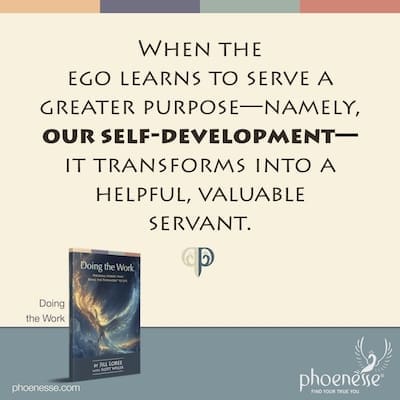
When the ego learns to serve a greater purpose—namely, our self-development—it transforms into a helpful, valuable servant.
How friction leads to healing
Here on planet Earth, we have better opportunities for reuniting our fragmented selves than in the Spirit World. For here, unlike in the Spirit World, we are surrounded by other fragmented beings whose fractures snag against our fractures. That creates friction.
In acting out our negativity, we bump up against each other. And when that happens, it shows us where we have personal healing work to do.
This friction, then, is the advantage of coming here. It creates the mirror that allows us to see our soul dents.
In the Spirit World, we exist in spheres made up of like-minded souls—"people" with similar soul dents. So we get along better but don't grow as much.
Getting the chance to come to Earth, then—to live in this incredible teaching environment—is highly desirable for us fallen spirits.
But since we are all fractured souls, we need something to hold our fragments together. This is what the ego does. Even though it, too, is a limited fragment.
Since our fragmented layers are what Pathwork calls our Lower Self, the ego is also part of our Lower Self. Problems arise when it thinks it rules the world.
For the ego rules with one-sided selfishness.
But when the ego learns to serve a greater purpose—namely, our spiritual self-development—it transforms into a helpful, valuable servant.
Once our ego develops some self-discipline and becomes healthier, it changes. We learn to reach out for help.
We start to knock on the door of our Higher Self. And when that door opens, our healthy ego steps aside and lets our greater self come forward.
This is how we heal ourselves.
This is how we bring more light into life.
Letting go and letting God
Over time, a strong, healthy ego will master the art of letting itself go of itself so completely that it will reunite with our Higher Self. This is the ultimate destiny of all our fragmented parts.
As this happens, we come to know ourselves. And since our Higher Self is an aspect of God, this is how we also come to know God.
This is how we gradually re-align our will with God's will, which is our ticket home to God.
For now, each of our fragments holds both pain and untruth. To align with God's will—to become once again compatible with God, so we can reunite with God—we must restore ourselves to our original truthful condition.
We do this by discovering how—in what specific way—we are currently not in truth. Somewhere, buried in our unconscious, we harbor misunderstandings about life.
How does the ego do this work of self-transformation? By asking others for help—and by praying. For on this spiritual path, we are going up the steep side of the mountain. Each time we climb a little higher, we gain a toehold—a tiny, precious grip—on the truth.
When should we pray and ask for help? Any time we are in conflict or disharmony. For that's a clear sign we are not in truth.
What should we pray for? To know the truth of the matter.

In Jill's Experience
I was attending a sales meeting, having recently moved into a sales position that involved a high-profile customer with a large opportunity for business. I had timed it well and sales were increasing nicely. I felt good about my work.
That is why, when the group manager stood in front of the group handing out accolades and I wasn't mentioned, I was so stunned.
To the young, wounded part of me, this felt devastating. Afterwards, I mustered the courage to ask this manager why I hadn't been included. Having caught him off-guard about such a significant oversight, he shrugged and said, "Oops, sorry about that!"
Back in my hotel room, I was reeling. While true, this was a painful thing, it had cut to the quick of my old wound. My reaction of hurt and indignation was greater than this situation warranted. I was in tears and trying hard to numb the feelings bubbling up.
The only small bit of perspective I could gather was the awareness that I must not be in truth. So that was where I sat, for several long minutes. I was just breathing—consciously overcoming that old pattern of holding my breath—and praying to know the truth.
And then it happened. Something started to shift, and then to open. I started to see a perspective I hadn't considered before: he had made a mistake.
This manager, standing in front of a room full of people, had overlooked something important. And when asked about it, he did not acknowledge his mistake and say he was sorry. And that's on him. What happened was actually not about me.
The more I cried and breathed into this new take on reality, the more I opened to seeing that this wasn't really as painful as it had seemed. Sure, it stung. But more truthfully, it had scratched open my old wound about not being seen as a child.
That was what really hurt.
In reality, as we go through life, sometimes we get overlooked. While that doesn't feel good, it's really not the end of the world. I let go of my case and went to sleep.
The next morning at breakfast, this manager approached me and told me he was sorry. It had been a big oversight and he deeply regretted it.
A short while later, as the meeting got underway, he stood in front of the group and made it right. I was both seen and acknowledged in front of the group for my contribution.
In Scott's Experience
It was the middle of the night, and I was sitting on the curb in front of the airport in Jakarta, Indonesia. Exhausted, frustrated, annoyed. I had been awake 24 hours.
I tried to put a serene face on it all, but it was a bad start to a long return home.
The previous evening, business concluded, my taxi crawled through the impressive Jakarta traffic to the airport for a midnight flight out. But I was denied boarding due to a ticket mishap, and my calls to Delta couldn't straighten out the situation before the plane pushed back.
I was escorted out of the airport to the curb.
A few weeks earlier, Jill had pointed out to me that I gave an air of being special, or wanting to be seen as special, because I traveled frequently. There had been a "look at me" kind of air about how I talked about where I get to go, or the shorter lines I got due to "status" with the airline.
So as I waited for my 4:30 am check-in—cooling my jets, so to speak—I prayed to know the truth of the situation.
The inner response when I was denied boarding was a cascading stream:
Indignation. "But I have status!"
Anxious pleading. "God, please step in and fix this. You got this, right?"
Fretting. "I've been abandoned. Again."
Irritation. "Inept airline people!"
Gratitude. "A lot of people worked hard to help me."
Wanting to feel special. "Yay, I have another travel story to tell."
And curiosity. "What does this experience have to teach me?"
My outer response to the gate agents wasn't completely chill, but it was respectful. Fortunately, I didn't make it painful for those around me.
As I prayed for truth, I felt the proximity of the child consciousness feelings of pleading and abandonment next to the feelings of indignity and being special.
That little boy inside me wanted to feel seen and loved, and when that didn't happen the way he wanted, he childishly latched onto wanting to be seen as special. When being special didn't happen, the old stories came up. Then the stories got covered up by feelings like anger and disheartenment.
The child inside me couldn't have things the way he wanted, and my work was to help him grow up. I literally had to pause, connect with that part, and slowly re-educate him. That's the task as an adult. No one else can do this for us.
And I had to mature as an adult. I had to learn to accept life as it shows up, without attaching false stories. That's part of the work too.
Return to Doing the Work Contents