Embedded in every fault is the belief that we need it.
Somewhere inside us, we believe this fault will keep us safe or get us what we really want—ultimately, love. Of course, it does neither.
Instead, it creates more of the very pain it was meant to prevent.
But faults aren’t all bad. They are always a distortion of something divine.
We don’t destroy our faults—we restore them.
We do this by getting to know them, understanding what they are trying to accomplish, and exposing the error in their thinking.
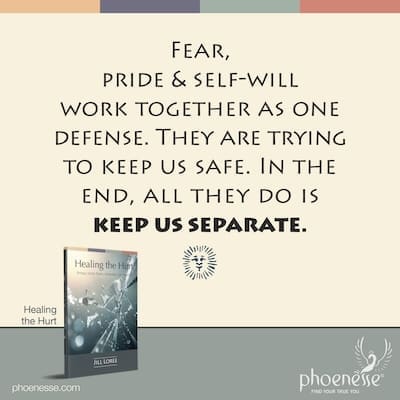
Fear, pride and self-will work together as one defense. They are trying to keep us safe. In the end, all they do is keep us separate.
How our faults protect us
All faults arise from a child’s desire to protect itself from pain. As we grow older, they can become highly destructive—the true root of our problems in life.
Our three main faults are fear, pride and self-will, and they are inseparable. All faults fall under one of these three categories. If we uncover one, we can always find the other two.
Worker: I found out my friends got together without me. I’m furious. I don’t even want to talk to them now.
Helper: What are you afraid of?
Worker: That they don’t really like me.
Helper: And if they don’t?
Worker: Then… I guess I don’t matter to them.
Helper: And how does it feel to not matter?
Worker: Like I’m nothing. Like there’s something wrong with me.
At this point, the Worker starts encountering the original pain.
Helper: What do you want to do with this feeling?
Worker: Cut it off. I’ll have nothing to do with them.
Helper: What would that accomplish?
Worker: They can’t reject me if I reject them first.
Helper: And what would you hope would happen then?
Worker: They’d come after me. They’d realize they need me.
Notice what is happening. The Worker is not simply angry. The anger is protecting something much more vulnerable underneath.
In this scenario, the Worker feels rejected. This triggers the faults that formed around the original wound of feeling left out as a child.
They are trying to solve a real problem using the limited logic of a child who does not yet know how.
Fear says, “I’m not wanted. People will see that I’m not good enough.”
Pride says, “I must never let anyone see that I’m unimportant.”
Self-will says, “I refuse to surrender to this feeling. I will withdraw first, so I remain in control. Then they’ll come after me and prove I’m wanted. I’m not powerless.”
We set the mechanism of our faults into motion when we cut off the original pain. As children, we couldn’t bear it. The pain feels as though it could destroy us.
And because children naturally assume that what happens to them reflects something about themselves, we conclude that something must be wrong with us. We must not be enough. We must be less than.
This feels humiliating, and we fear that others will see this “truth” about us—that we’re inadequate. So we hide our pain, from ourselves and from others, which leads to shame.
Then we pretend we are better than we believe we are. This is pride.
Next, using our self-will, we try to control the situation, so we won’t have to feel it. We withhold ourselves and build inner walls, hoping to shield ourselves from this inevitable pain.
This is how fear, pride and self-will work together as one defense. They are trying to keep us safe. In the end, all they do is keep us separate.
We think the painful feeling is the problem.
The Guide says our resistance to the feeling is now the problem.
The image beneath the fault
The pain is not the fault. The fault is the defense against the pain.
The image is the belief underneath the defense.
The image says, “This is how life works:
People will humiliate me.
If I need someone, I will be hurt.
I have to win to be safe.”
These conclusions are not conscious decisions. They are the conclusions a child draws from painful experiences. Later, we forget that we ever made them—but we continue living as though they are true.
The parts holding this pain are fragments of consciousness that became separated when we were young. This is the Little-L part of the Lower Self—the young fragment that says, “I can’t.” As in, I can’t feel this or I’ll die.
We want to help the Worker see that they can feel this pain. In fact, the only way out of this pain is to go through it—to die into it. We must express the pain and then discover the untruth it is holding.
Going through the pain
In the end, every fault is a desperate attempt by our Lower Self to solve an impossible problem. We believe we can’t tolerate pain. But this is not true.
By tolerating these strong feelings, the Worker gains a sense of self-respect. This is the dignity they were missing when they were running.
By facing ourselves, we illuminate the truth:
The pain isn’t what destroys us.
The fight against the pain is what keeps us trapped.

Return to Healing the Hurt Contents