Gems
Gems
A collection of 16 Pathwork teachings

THE REAL.CLEAR. SERIES, Book Six
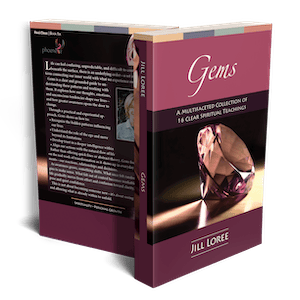
Gems: A multifaceted collection of 16 clear spiritual teachings
Life can feel confusing, unpredictable, hard to control. But beneath the surface, there is an underlying order—a set of patterns connecting our inner world with what we experience outwardly.
Gems is a clear and grounded guide to understanding these patterns and working with each facet. It explores how our thoughts, emotions and unconscious tendencies shape our lives—and how greater awareness opens the door to change.
It’s is not about becoming someone new. It’s about seeing ourselves clearly and allowing our divine nature—that is already within us—to unfold.

Deconstruction is part of the process of construction. If something isn’t put together correctly, it needs to be disassembled so it can be put together in the right way.
Chapter 5: Finding balance within instead of relying on outer rules
CONTENTS
1 The evolutionary process and why we can't stop it | Podcast
We may periodically have the universal dream of either riding on a train or being about to take a train, anxious that we may miss it, have missed it, or are getting off the train.
Such dreams reveal a deeper truth about life: Do we want to follow our inner evolutionary process or stay behind? Because the train is always moving.
If we choose to go on a path of self-searching, hoping to find more meaning in life, we are making a choice—just as we are making a choice when we choose not to do this.
2 How consciousness evolves between individuals and groups | Podcast
Over the past few hundred years, the emphasis has been on the individual. Now, that phase is ending. This doesn't mean the individual is no longer important. Rather, the emphasis must now shift once again to the group. But which kind?
True group consciousness honors and supports individuals, but mass consciousness eliminates them. Mass consciousness doesn't require individuals to stand in their own feel—it stops this, by imposing conformity and blind following.
Which kind of consciousness do we want to develop?
3 Claiming our full capacity for greatness | Podcast
As we wind our way down the road of personal healing, we will increasingly come to believe that it's possible to resolve our inner problems. We can put ourselves back together again.
In the beginning, our work must focus on whatever is negative within us: our faults of self-will, pride and fear, our wrong conclusions about life, and our selfish, destructive attitudes.
All this must continue as we roll forward into the second phase of our work: claiming our full capacity for greatness.
4 Our great longing for eternal life | Podcast
It is convenient to believe that after we die, we'll revert to our whole selves. Not so fast. The aspects living in the darkness of fear and doubt will stay unconscious after they leave the body.
This is what perpetuates the illusion that physical death is like dropping over the edge into extinction. But don't worry, the not-yet-awake aspects will get to come back again—and again—until they eventually wake up.
In the awakened state, we have no fear. You could say we feel cozy with life. Life fits us like a glove. The vibrational frequency of this state of safety bears no resemblance to a false faith covering over faulty ideas.
5 Finding balance within instead of relying on outer rules | Podcast
When things are out of balance, there is disorder and disharmony. When we do the work of uncovering our unconscious parts and cleaning them up, we are reestablishing balance.
But balance doesn't come by way of a mathematical formula. It's not a fifty-fifty deal. For example, what's the right balance between sleep and being awake?
In short, we have to look within to find the right measure. But humans like to find refuge in rules. We like hard-and-fast directions we can accept without thinking.
6 Embracing change and overcoming fear of death | Podcast
There is the seed of a plan buried in the heart of all divine substance. And the designs call for continual growth—for expansion—to infiltrate all that is.
Implied in the movement of expansion is the willingness to change. Or perhaps we're more familiar with the countermovement we feel in our soul—the fear of change.
7 The pain of injustice and the truth about fairness | Podcast
The pain of injustice contains much more than can be expressed by this word "injustice." Because our pain is not just about injustice that is happening to us, here and now. It includes a fear that we live in a world where destruction can happen—and there are no safety nets.
But that alternative is what the dark forces whisper into our ears. They want us to remain in pain and confusion, disconnected from the greater reality of life. For if we stay in the dark, we'll strain against the pain of an unjust universe.
We won't see the beauty of God's creation and the justice that permeates it all. We won't see the truth that—really and truly—it's all good.
8 Why lazy is the worst way to be | Podcast
When we're weak and won't stand up to evil in others—when we won't fight for the truth—we're encouraging evil.
We fear that if we stand up for decency and exposing the evil, we'll be the one who gets ridiculed. We sell out in order to not be rejected.
Here's something interesting to ponder: the active principle in distortion—as murderous and harmful as it might be—is never able to cause as much damage as the receptive, passive principle in distortion.
So the lowliest attribute on the bad-ways-to-be scale of humanity is not to be hateful, it is to be lazy.
9 Spotting the tricks of our ego and getting over ourselves | Podcast
The human mind is like a fragment of stained glass in a gorgeous stained-glass window: it's part of something greater. But by itself, it's only a small piece.
It is our goal then, through the process of incarnating, to figure out how we fit into the bigger picture. The trouble is, we think our fragmented self—our ego-consciousness—is all there is.
The ego then is a separate fragment that is under the illusion that to enlarge itself will mean to blow itself up. But we need to do exactly that: let go and expand.
In short, we need to get over ourselves.
10 Four keys for reaching our cosmic core | Podcast
Just imagine what it would be like to have the total absence of fear.
For many of us, we're so unaware of all our fears and so used to them—it's like we're a fish and they're the water we're swimming in—it doesn't occur to us there could be life beyond our fears.
In this state, there can be no worry or anxiety. This is an experience that's at once spiritual and emotional as well as mental and physical. It envelops a whole person. And there are four keys that make it possible to attain.
11 Balancing inner and outer control | Podcast
As we transition from ego-driven living to alignment with the deeper self, it may feel like two selves exist inside—the ego and a deeper inner presence.
This apparent split is an illusion created by our lack of awareness.
The paradox is that, on one hand, it is true that we are separated, or divided. On the other hand, it is not true—everything is all one consciousness, one whole. This experience of having two beings inside us is the beginning of resolving the paradox.
12 Four practical steps for finding faith and addressing doubt | Podcast
We often think of faith as a blind belief in something we have no way of knowing. And indeed, if that's what faith's about, it would be right to discard it.
For who wants to be naïve and believe in something that has no grounding in reality and can never be experienced as truth? This perspective keeps us perched on a platform from which the only things that are real are what we can see, touch, know and prove.
From here, we will never have to leap into the unknown. But here's the rub: the only way to expand and change is by leaping… into the unknown.
True faith involves several steps, or stages, each highly grounded in intelligence and reality. There is nothing unrealistic about this approach. There is no blind belief called for.
13 Realizing our desires by letting go of our demands | Podcast
Eastern philosophies often support the notion that desirelessness is ideal. And this is true. But it's only half-true.
Because it's impossible to create if there is an absence of desire. It all comes down to how we go about this.
If our desire is overly strong and too tight, there is a misconception underneath it that says, "I must have it." So the desire is not really a desire, but a demand.
Then if life doesn't give us our way, it is bad and unfair. Then we'll go on to prove how unfair life is through the dismal results we create with our unfair demand.
14 How to visualize living in a state of unity | Podcast
When we embark on a spiritual path, our growth and expansion propels us toward new experiences and higher states of consciousness.
One essential aspect of our creative process is visualization. Because if we can't envision the state we want to grow into, it will be hard to ever get there.
We need to see the prototype provided by someone who's gone before us.
15 Surrendering to the double-sided nature of duality | Podcast
We actually all start our journey back to heaven by climbing out of the dark depths of hell.
In fact, we start out in such a state of darkness, there is essentially unity. Only as we develop and our consciousness gradually expands does the positive polarity come into play.
Duality, then, is actually a step in the right direction. On the far end of the spectrum, when we reach our full potential, we will once again be in unity.
What we really need then, at this point on our journey, are some tips for overcoming duality.
16 Relaxing into the struggle to find the Oneness | Podcast
To our way of seeing things, we have been put into a world that is an objective, fixed place—everything is ready-made.
Submitting to this version of reality, false though it may be, seems to make the most sense. To a degree, this assessment is correct. We do need to accept the world the way we find it and deal with it on its terms. At the same time, we have a new vision of things rising up from the fog.
With this new awareness, we know—in our core, not just in our head—that there is only good, only meaning, and nothing to fear. Knowing this is not a burden—it liberates us and makes us feel safe.
But also, by knowing this, it may be tempting to skip over grappling with duality. This type of thinking comes from a childish desire to be ruler, even if we have to cheat our way to the top.
Afterword | Podcast
©2016, 2026 Jill Loree. All rights reserved.

Real.Clear. series | Holy Moly • Finding Gold • Bible Me This • The Pull • Pearls • Gems • Bones • Nutshells • Speaking Pathwork
We Can Heal | After the Ego • Blinded by Fear
All essays | Get a Better Boat • Living Light • Latest essays
Self.Care. series | Spilling the Script • Healing the Hurt • Doing the Work
More books | Walker • Word for Word • Spiritual Laws • Keys
To share, choose your platform