We start to notice where our work is by noticing when we have "emotional reactions." These are our sudden responses to people and situations that trigger our old pain.
We can spot emotional reactions by the way they cause a bigger response in us than the situation calls for. We can see this perspective by asking ourselves if someone else—certainly not me, but somebody else—might face the same situation and not be so bothered by it.
If so, then maybe our feelings aren't ironclad facts.
We often have a long history of intentional—albeit unconscious—numbing behind us. As we start to grow emotionally, our emotions confuse and disorient us.
For one thing, we will experience feelings we don't like. And these immature feelings won't surface in tidy ways. In fact, the work of feeling our feelings can be messy and noisy.
We understand that the process of growing up mentally and physically can be challenging. The learning process involves making mistakes. Yet, over time, we can master more and more difficult material.
Intellectually, no one expects college-level work from a fifth grader. In a similar way, our bodies gradually develop strength and coordination as we grow up. We all know that it takes time, effort and perseverance to develop athletic skills.
But when it comes to our immature feelings, we have different expectations. We don't want to go through the process of expressing them so they can evolve and mature. And we don't want to feel the vulnerability needed to do this.
In short, we don't want to let down our guard. Yet that is the only way to discover that keeping our guard up is our big problem.
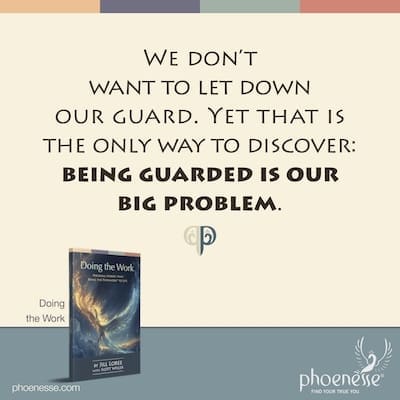
We don't want to let down our guard. Yet that is the only way to discover: being guarded is our big problem.
Finding our guiding light
Our emotions will need our time and attention. We must work through the steps we skipped when we decided not to feel them. Even expressions of joy and happiness may take some getting used to.
It isn't possible to pick and choose our emotions. We can't suppress the feelings we hope to avoid while wanting free access to the ones we like. If we block our painful feelings, we block positive feelings as well.
We all have frozen feelings to some extent. This is due to the script we all follow in becoming human. We will feel a particularly strong ache when we first begin to emerge from numbness. It's much like submerging freezing-cold fingers into a pan of lukewarm water.
To heal these old wounds, we need to do this work with someone trained to help us. To be clear, we don't just aim our pent-up emotions directly at those who trigger our emotional reactions.
Our stuck, painful feelings are bundled together with invalid, unfair conclusions. To walk a spiritual path means we take responsibility for this. We must release our old feelings in an appropriate way. And we must unravel our twisting thinking.
All this takes the blame off others, even though we recognize that they, too, have inner work to do. Retaliation, retribution and revenge only serve to keep us stuck in old patterns. They keep us locked in our Lower Self, and therefore temporarily locked out of heaven.
By working with a trained person, we learn to access and express what is currently inside us. In this way, we make space for something new—new wisdom, new perspective, new compassion, new courage—to be born in us.
Once we shift our relationship with our own inner wounds, we will be able to re-engage with the people and situations that challenge us. But we will bring new awareness and therefore new possibilities for shifting our relationship with them.
We'll be able to move toward connection, instead of furthering separation.
Until this happens, our frozen inner blocks will obstruct our inner light. It is this light that is available to guide us.
What part takes the lead?
If we're attuned to the voice of spiritual seekers everywhere, we've likely heard the mantra that there is only one force in the universe, and that is love. It's true that at the core of our beings we are deep wells of never-ending love.
Nonetheless, the temporary truth on the surface of our beings—covering over our Higher Self—is often anything but love.
We all have these dark layers of Lower Self, made up of things like hate and spite, greed and envy, anger and rage. If we don't yet recognize this in ourselves, we have not yet scratched the surface of our inner work.
Since such non-loving feelings are present now, that's what we must pay attention to. To look the other way is to continue walking in darkness, wearing a mask of defenses.
When we're in an emotional reaction, the real problem is that an inner fragment has been activated. This split-off part of our psyche is now coming to life.
In doing so, this part is now reliving the pain of a previous experience we couldn't manage when we were young. In the blink of an eye, we have gone into an emotional reaction: fight, fawn or flee.
As we get underway in unravelling this mystery, our adult self becomes aware of this inner child. Next, we start bringing reason to our emotions. We now know we must be holding a mistaken belief. It's buried in our psyche, so we must search a bit to find it—to hear it.
We can always start with simply seeing that we're in disharmony, so we must not be in truth. In this process, it is our ego that must first wake up and notice what's going on.
The ego pauses and takes a breath. We pray to open the inner doorway to the Higher Self. The Higher Self holds the divine qualities of love, wisdom and courage, and is waiting for us to tap into them.
The ego must remember to pray.
How and why we become inauthentic
The soul of every human being is made up of three fundamental layers: the Higher Self, Lower Self and Mask Self. We all have areas in our lives where the fine qualities of our Higher Self shine through. But we also have Lower Self layers in need of transformation.
These are what currently block our light.
The Lower Self is a highly charged aspect of our beings made up entirely of twisted Higher-Self currents. There is not a single fault that can't be unwound to reveal its original glorious face.
In its low-frequency state, the Lower Self is not a thing of beauty.
The Lower Self has two main aspects, one of which is our immature fragments. We might call this our inner child. In this part of ourselves, we demand to receive 100% love, and we don't want to pay any price to have it.
For example, we won't make the effort needed to mature these split-off parts of our consciousness. Yet this is what we must do to give and receive genuine love.
In an effort to always get our way—and always be loved—we develop what we believe is an ideal version of ourselves. This, we think, will win us all the goodies.
Plus, if we succeed at perfecting this ideal—although unrealistic and inauthentic—version of ourselves, we think no one will see what we are covering up. Namely, our unpleasant Lower Self.
Then, depending on our personality, we will adopt one of three masks, or defenses: aggression, submission or withdrawal. Each distorts one of our three primary divine qualities. We then roll this into our idealized self-image.
The Power Mask distorts courage, the Love Mask distorts love, and the Serenity Mask distorts wisdom. The result is that we become a Will Type, an Emotion Type or a Reason Type.
It's important we get to know which is our favorite mask, or defense. But we should investigate all three, because we tend to use different defenses in different areas of our life, depending on which we think will work. Often, when we feel confident about our ability to succeed in life, we actually just have confidence in our mask.
Two important points about the mask
There are two important things to note about our defenses. First, this mask layer is not real. Our defenses are strategies for keeping us safe—for avoiding the pain of not being loved or getting our way.
Our goal is to hide our shameful belief that we're just not lovable.
Yet these ineffective strategies are actually not energized. Meaning, we can take off our mask—we can lower our defenses—whenever we are ready. We can choose to change this behavior.
After all, no one buys the mask.
Others can tell when we are not being genuine. People don't like to feel manipulated, so our defense triggers reactions from others.
So this false way to get love doesn't even work. It doesn't bring us love. Instead, it creates more pain.
Second, to do serious self-transformation work, we must deal with our Lower Self. To do that, we must risk becoming more real. Because the Lower Self is highly energized. It's very real.
We simply cannot fight our Lower Self without facing our highly charged painful feelings.
Note of caution: in doing our own work, we are apt to start noticing other people's masks and Lower Self. But each person must decide to do this work themselves, and it must be done with care. This work can be destabilizing if it is not done intentionally and methodically.
The truth is, we provoke the defenses of others when we stay in our mask. Focusing our efforts on our own ability to live with authenticity will offer the most effective help for everyone.

In Jill's Experience
We each have a personal favorite way of responding when we get our feelings hurt. Will Types try to control their world by overpowering and manipulating others. Emotion Types submit, but only to force others to give in to them. Reason Types, like me, check out. We try to become invisible while being in plain sight. We run, if only on the inside.
My tendency to run comes up in my relationship with Scott. It happens when I see him through my old distorted lens of "he intends to hurt me," or "I didn't make the cut."
Note, there doesn't need to be any truth to these perceptions, for some young split-off aspect of me to take off. By the time I realize I've gotten my feelings hurt, parts of me can already be across town.
In those immature parts of me, I cannot tolerate the intensity of some old pain. This is when I literally need to sit and hold these hurting parts of myself, actively asking my Higher Self to be present in the moment.
I need to release the pain she is carrying, hear what untruth she is holding, and re-educate her with the wisdom that flows into me from my inner connection with the divine.
We might think, "Our Higher Self is always there, so why must we invite it in?" Because our work is to open the doorway, to actively want to connect with God within.
That's what makes doing this work of self-knowing "spiritual."
Even though God has been with us this whole time—our Higher Self is made from the essence of God—I must remember to knock and ask God to come in. Then, as one of my spiritual teachers would say, God rushes in to where God already is.
In Scott's Experience
I lean most strongly toward the emotion type of defense. But I didn't see this about myself early on. I thought I was a will type. I was far off the mark and had a lot of misunderstanding about defenses.
The subjects introduced here—the three reactions, masks, defenses and personality types—are straightforward. They are usually presented in the first year of this work, before the focus moves on to deeper areas.
For me, though, these subjects have been among the most difficult to truly know and master. Even now I keep coming back to study them more deeply.
When I started my inner work I would describe myself as a person who was stuck emotionally, but with a strong will and a sharp intellect. I noticed the will side the most in my Pathwork.
Where we have faults, we always have pride, self-will and fear. So we can access our faults through any of those three doorways.
When I worked with my Helper exploring my emotional reactions, the entry point was often fear. I could perceive a tight knot of fear somewhere in my body and dive into it.
Once the fear dissolved, things shifted to perceiving a tight, over-active will current inside. I used my will to guard against feeling and to inwardly try to force life to be different from what it was.
I ran into this willful pushing and forcing of life again and again. I used so much life energy in a painful and completely useless way. Useless because life doesn't respond to being forced.
After years of experiencing this in my sessions I concluded, wrongly, that I must be a will type. I didn't understand that all three defenses feature a misuse of our will. In all three defenses we use our will to try to force life and others to bend to our demands.
With the will type, it's right there on the surface, callously overpowering others. It was tempting to point to those people as using a "worse than" defense. As in, "your defense is worse than my defense."
I dropped these foolish thoughts when I came to understand the tyranny that lies well-hidden in submission and withdrawal.
Next Chapter
Return to Doing the Work Contents